History of Social Media and AI
Social media initially emerged as a platform for connecting people virtually, allowing users to share their thoughts, experiences, and create connections over various apps like Six Degrees, Friendster, MySpace, and LinkedIn. In 2006, Facebook was created, which quickly dominated over the existing platforms (Maryville University, 2020).
Introduction of AI within Social Media: In 2007 Facebook diverged from their original algorithm of a chronological feed structure, and began using EdgeRank (Edward, 2018). The EdgeRank system utilized three primary factors to decide what to push to users feeds: recency, engagement levels, and user relationships (Sprout Social, n.d.). EdgeRank operated with predetermined formulas instead of true artificial intelligence, and was eventually replaced by AI-driven algorithms in 2016 (Sprout Social, n.d.). Other social media platforms including Instagram and Twitter followed Facebook’s algorithmic implementation, using these systems to enhance user’s feeds instead of just pushing the newest posts from their friends (Edward, 2018).
Today, AI is used in many ways throughout different social media platforms, including content curation, generating insights, monitoring content, fact-checking, creating content, and many more. These systems are integral in apps like Instagram, Youtube, Tiktok, and Facebook (Schoppa, 2022).
Real World Application Examples
Content Curation
Social media algorithms function as AI systems that analyze user behavior data to curate content based on individual engagement and expressed interests. These machine learning systems process user data to refine content recommendations, creating a tailored digital experience that aligns with a user’s preferences (Schoppa, 2022).
Advertisement Targeting
Modern algorithms have highly advanced abilities that learn user preferences and return targeted advertisements based on the user’s behavioral patterns.
This is why it feels like our phones or computers are sometimes “listening” to conversations, however this perception comes from algorithmic content prediction and not audio surveillance. When a user’s online connections search for or purchase a product, algorithms can identify any similarities in behavior, and then push targeted advertisements for the same product. All of a user’s online behaviors add to their data profile and can be used to determine the next advertisement or business recommendation by the algorithm (Taylor, 2021).
Friend Suggestions
The most common way for social media to know who to suggest for friends is by finding them through your contacts. However, there are many other ways to suggest people you may know including collaborative filtering and the use of the common neighbor algorithm. Collaborative filtering combines many different factors of a user’s social media presence including interaction patterns or profile information to find people they may know. The common neighbor algorithm, which is used by Facebook, connects people through mutual friends. This approach mirrors real-world social situations, where individuals commonly meet through existing friends (Zhu et al., 2021).
Societal, Ethical, Environmental Impact
Social Impact: Mental Health
Though social media started as a way to virtually connect with friends, it has evolved into a source of dopamine stimulation through unlimited content streams, never-ending notifications, and information overconsumption (Goldman, 2021). AI-driven algorithms continuously adapt to user preferences, learning what content keeps the user engaged. By continuing to deliver the content that keeps the user engaged, this creates an endless supply of dopamine-triggering material that keeps the user from leaving.
The objective of this curated content is user retention, by keeping the individual consistently engaged with the platform while simultaneously showing them advertisements that the user will want to interact with. These algorithms are behind the rising social media addiction rates, as content remains accessible and is always adapting to match user preferences (De et al., 2025). Social media addiction poses a significant risk to mental health, as prolonged use of social media is very likely to result in increased chances for mental health issues like anxiety or depression (De et al., 2025). This occurs partly due to the heightened levels of dopamine experienced during social media use becoming difficult to replicate, which creates a dopamine-deficit in the user (Goldman, 2021).

Social Impact: Information Bubble
An information bubble is the information that is directly accessible to an individual, including social interactions, media consumption, and visible content (Renze, 2021). These information bubbles become problematic when users fail to seek diverse and unbiased information sources. Algorithms are exceptional at creating information bubbles by continuing to narrow content exposure based on user interactions (Rodilosso, 2024). As individuals consume only within this circle of curated information, algorithms will continue to send out similar content, which creates this bubble of repeated ideas or opinions. This bubble can cause a user to believe that their curated perspective is representative of the truth, and dismiss any opposing viewpoints (Rodilosso, 2024).
Political content is a common example of an information bubble. When an individual favors a particular political party and begins to engage with related content, algorithms will learn this and begin to amplify similar content. Heightened exposure to specific filtered information can cause a bias without access to balanced information.
This is very helpful from a business perspective, however, as companies can ensure advertisements are reaching users who are most likely to interact or make purchases. Algorithms will show users content it knows they will interact with, predicting and influencing their behavior.
AI creates these information bubbles with two main mechanisms, Recommender Systems and Machine Learning Algorithms (Rodilosso, 2024).
Recommender Systems
Recommender Systems analyze user interactions to suggest other items or connections through three relationships: user-product relationship, product-product relationship, user-user relationship. For example, a user-product relationship would be if the user is an artist, they would probably look for paintbrushes. Then, a product-product relationship would be that a user who wants paintbrushes would also look for canvases. Finally, a user-user relationship would be that the user who is an artist would probably be interested in other artists. This data is found through user interactions either by specific product ratings, searched items, or showing similar products to either what the user searches or what their connections search (Shetty, 2019).
Machine Learning Algorithms
Machine Learning Algorithms process data or interactions to execute specific tasks, using various different methods including linear regression, logistic regression, and decision trees models (GeeksforGeeks, 2023).
Ethical Impact: Algorithmic Biases
AI algorithms are trained from interactions and data. When the source data contains inherent biases, the algorithm will also be trained to be biased, and spread these biases in operation. Biased training data can cause lack of information or spread inaccurate data. When algorithms incorporate societal biases, their use in different areas like finance, healthcare, the justice system, or employment, can produce discriminatory outcomes (Jonker & Rogers, 2024).
Ethical Impact: Transparency
AI algorithms can become very complex, and can stray from their intended use. In some cases, developers create systems so elaborate that even the creators cannot fully understand the systems decision-making processes (Huriye, 2023).
The lack of transparency with accountability for the algorithm’s behavior and outcomes presents an ethical dilemma. This idea is known as the “black box” phenomenon, where the user or developer can see inputs and outputs, but the inner workings are incomprehensible (Blouin, 2023).

Environmental Impact: Energy Consumption & Data Centers
Data centers that focus on AI operations need substantial power resources. In North America alone, consumption reached 2,688 megawatts in 2022, grew to 5,431 megawatts in 2023, and is estimated to reach 1,050 terawatt-hours in 2026 (Zewe, 2025). Water consumption in data centers is also a growing concern, with smaller data centers using about 18,000 gallons of water per day, while major data centers operated by companies like Google, use about 550,000 gallons per day (Pinheiro Privette, 2024).
Example: Analysis of 2023-2024 data showed that ChatGPT consumes about 40 million kilowatt-hours per day (Wright, 2025). Given that the average American home uses 10,791 kilowatt-hours annually, ChatGPT’s single-day energy usage could power about 3,700 American homes for a year(Marsh, 2023).
Relevance Today
AI algorithms are present everywhere in modern-day digital life, as anyone who owns a smartphone is regularly interacting with these systems through Google search, Apple Intelligence, and social media platforms like TikTok, Instagram, and Facebook to name a few. Even though these algorithms are integrated in everyday life for the majority of the population, there is limited understanding of how these algorithms are trained and how they deliver content. Most users are not aware that they are training these algorithms every day through their daily phone usage.
Currently, over 60% of the world uses social media, with the average individual using social media for over two hours per day. Understanding how these algorithms work is important for being digitally aware (Backlinko Team, 2025).
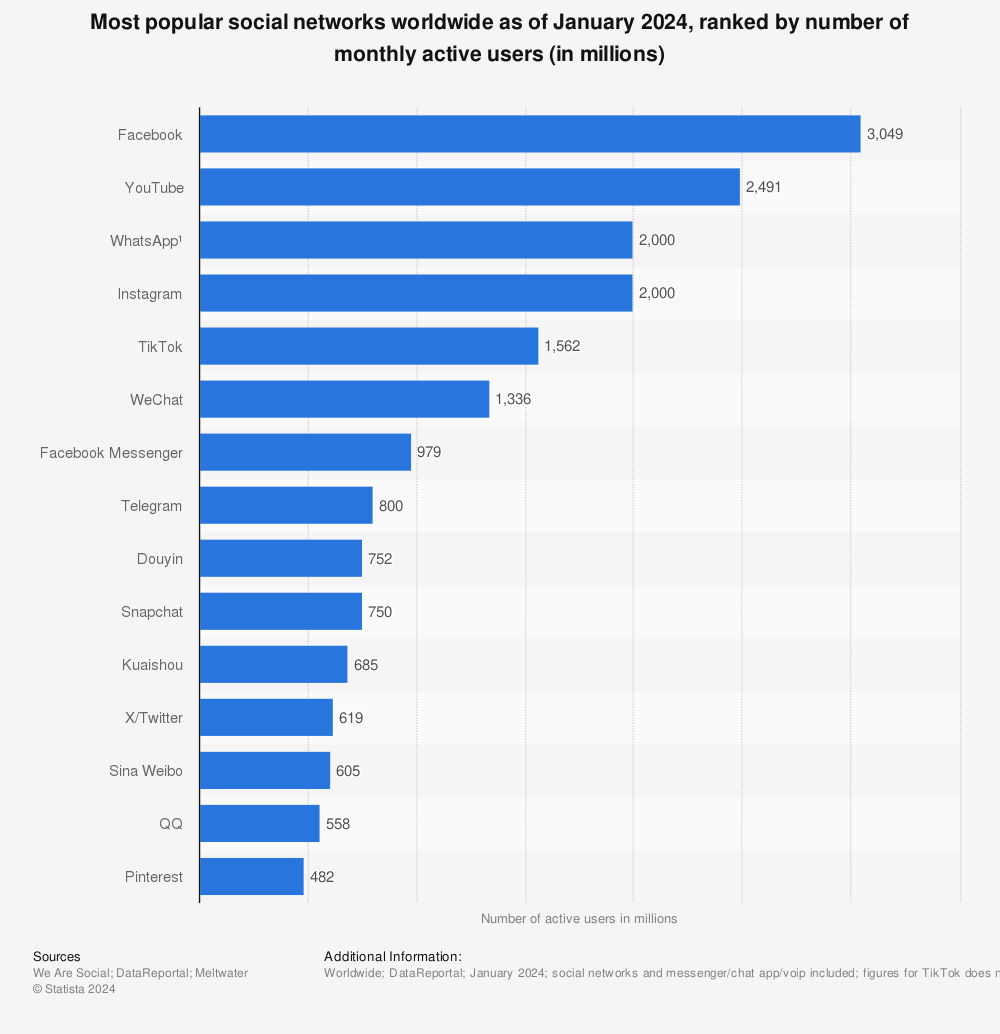
Figure 4. Most popular social networks worldwide (Dixon, 2025).